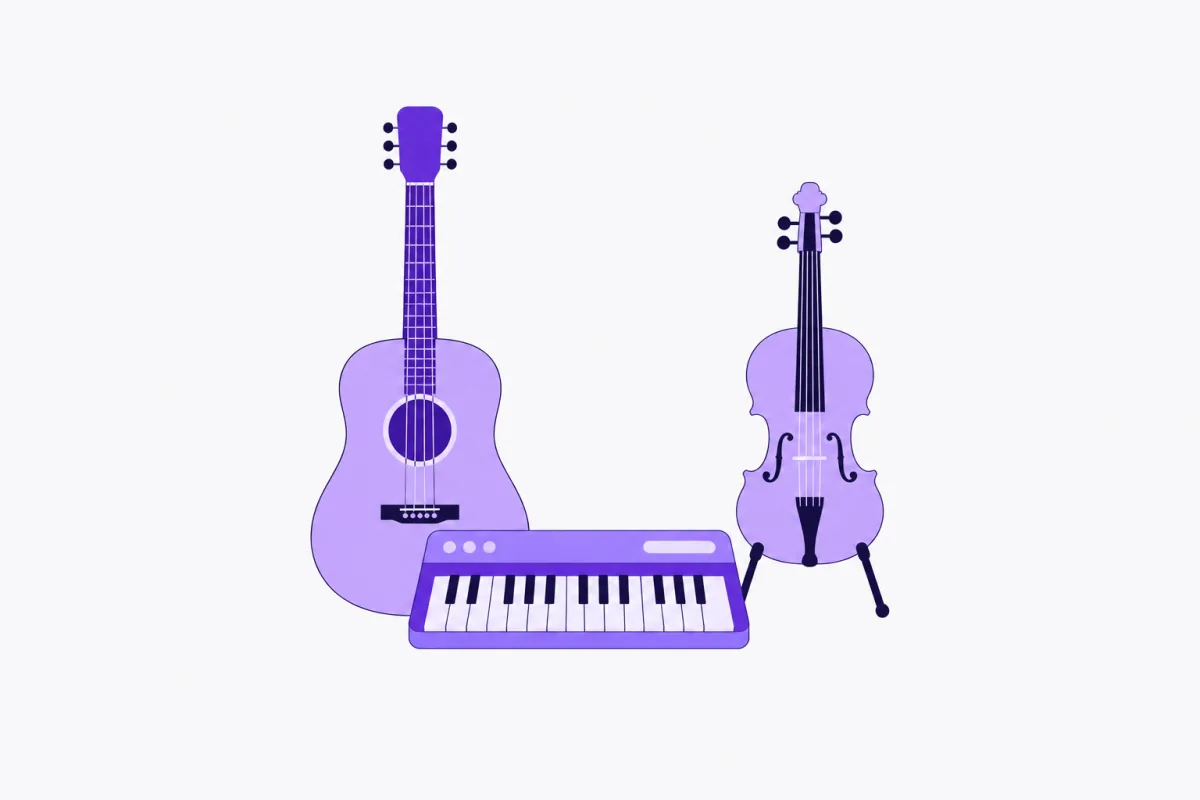
"Do you have the Yamaha keyboard with 61 keys in stock?" "What's the price of a 3/4 acoustic guitar for my daughter?" "Can you set up my bass if I bring it in on Saturday?" "Do you teach drums for adults?" A music instrument shop takes these questions all day, on the phone, on WhatsApp and from people standing at the counter with a guitar on their knee.
Most music shops have a catalog in someone's head and a supplier price list in a drawer. Customers want to check before travelling, because an instrument is a considered purchase and they want to try it. A full e-commerce site with shipping and payments rarely fits how a local shop actually sells.
An online store for music instrument shops can be much simpler. Aiva Chat's store is a searchable catalog of your guitars, keyboards, drums, amps and accessories, with brand, model and options on every page. Customers reserve an instrument to try and collect, order accessories on WhatsApp, or send a quote request for a school band. If you teach or service instruments, the same assistant books lessons and setups. This guide covers how that works, and what Aiva Chat doesn't do: it takes no online payments and it doesn't ship.
The music shops and scenarios in this post are illustrative composites, not real customers. Brand names are used as everyday examples only.
What is an online store for a music instrument shop?
In Aiva Chat, the store is a catalog at your workspace address, under /shop, that customers can search, sort and filter by brand and product details. The AI assistant reads the same catalog when it answers calls and chats. It's not a checkout. Customers can:
- Reserve for pickup: ask you to keep an instrument to try and collect today or tomorrow.
- Order on WhatsApp: one tap opens WhatsApp with the product, option and quantity filled in.
- Request a quote: send one request for up to 30 products with quantities.
- Ask about this: send a question about a product to your dashboard.
Each product has up to six photos, a price, up to three options, a stock status, a brand, a model number, a condition and up to 20 details of your own, such as body wood, number of keys, string gauge or pickups. Details are shown as a specs table, read by the AI and sent to Google with the product. The store page lists everything it does.
Lessons, repairs and setups run on Aiva Chat bookings, so the same phone line sells the guitar and books the first lesson.
How to build a music shop catalog
Step 1: Set up your categories
Nest categories two levels deep: Guitars, then Acoustic, Electric and Bass; Keys, then Digital pianos and Keyboards; Drums and percussion; Wind; Amps and effects; Accessories, then Strings, Cables and Stands. You can have up to 200 categories.
Step 2: Import your stock list
Export your stock or a supplier sheet to CSV or Excel and import names, prices, categories and SKUs. If you already sell on Shopify or WooCommerce, import that export instead. Rows that match an existing SKU update it, and new rows arrive as drafts for you to check.
Step 3: Draft instruments from photos
For instruments without a spreadsheet row, take a photo and AI drafts the product for you to check, using your own OpenAI key. Add your own photos of the actual instrument, especially for used stock.
Step 4: Add options and details
Add size, finish or colour as options, each with its own price if needed. Put the maker in the brand field and the model number in its own field. Add details such as top wood, scale length or number of keys, because customers search and filter on them.
Step 5: Price the way you sell
Use a fixed price, a from price, a range, quantity tiers for strings and picks, or price on request for high-end or custom instruments you prefer to quote. Price and stock changes from the product list go live straight away.
Step 6: Put it on sale and share it
Put products on sale, print shelf QR labels for the instrument wall, and share your store link with students, schools and local bands.
Benefits for music instrument shops
Fewer "is it in stock?" calls
Customers can check the catalog before calling, and calls that do come in are answered from the same stock status you set. The assistant never promises an instrument it can't see in the catalog.
Reservations that bring people in to try
Most people want to play an instrument before buying it. A reservation for tomorrow gives them a reason to come in, and gives you a name and email to follow up with.
Quotes for schools, bands and churches
A school buying ten recorders and two keyboards, or a band kitting out a rehearsal room, can send one request list with quantities. You reply with a quote that includes any trade discount you offer.
Lessons and setups booked without phone tag
Lessons, string changes and setups can be booked on your booking page, in chat or on a call. Reminders go by email with a link to move or cancel.
One assistant for the whole shop
The AI phone agent answers product questions, explains your lesson timetable and books a setup in the same call, in 13 languages, up to 2 calls at once on Starter, 5 on Growth and 20 on Pro.
Nobody buys a guitar from a photo alone. The catalog's job is to get them through the door with the right one waiting.
Music shop use cases
These examples are composites of a normal week at a local music shop.
The parent buying a first guitar
Problem: A parent wants a guitar for a nine-year-old and doesn't know which size. How Aiva Chat handles it: The assistant shares the size guidance you've written, shows the 3/4 acoustic options in stock, and offers to reserve one for Saturday along with a trial lesson. Outcome: The family arrives with a guitar to try and a lesson booked.
The school music department
Problem: A school needs fifteen ukuleles, five music stands and a keyboard. How Aiva Chat handles it: The teacher builds a request list with quantities and sends it as one enquiry. Outcome: Your team replies with a quote and a collection date.
The used amp that sells fast
Problem: A second-hand valve amp gets five calls in a day. How Aiva Chat handles it: It's listed as used with its own photos. When it sells, you set it to sold, and the assistant tells callers it's gone and suggests similar amps you have. Outcome: No disappointed trips.
The weekly drum student
Problem: An adult beginner wants a drum lesson every Tuesday evening. How Aiva Chat handles it: Drum lessons are a service with the teacher's hours. The assistant books a weekly repeating series and explains that lesson packages are paid at the shop. Outcome: A regular student without a single back-and-forth message.
Catalog vs. full e-commerce vs. social media posts
| Social media posts | Full e-commerce site | Aiva Chat store | |
|---|---|---|---|
| Searchable list by brand and type | No | Yes | Yes, with specs and filters |
| Options with their own prices | No | Yes | Yes, up to 3 options per product |
| Reserve to try in the shop | By message | Sometimes | Yes, today or tomorrow |
| Quote requests for several items | By message | Rarely | Yes, up to 30 products |
| Lesson and setup bookings | No | Usually a separate tool | Yes, same assistant |
| Answers phone calls | No | No | Yes, from the same catalog |
| Online payment and shipping | No | Yes | No, pay in the shop |
If most of your sales ship to other cities, a full e-commerce site is the better fit. If customers want to play before they pay, a catalog with reservations, quotes and lesson bookings matches how a local music shop already works.
How to set up your music shop in Aiva Chat
Step 1: Start with what's on the wall
List the instruments customers ask about most first, with options and prices. Count your plan's limit: 50 products on sale on Starter, 200 on Growth and unlimited on Pro.
Step 2: Write your shop information
Opening hours, trade-in or part-exchange policy, warranty, instalment options you offer, and how customers pay. The assistant answers only from what you write.
Step 3: Add lessons and services
Add lessons with teachers as staff, group classes with places, and services such as "Guitar setup" or "Restringing" with a duration and price.
Step 4: Add your WhatsApp number and pickup locations
Add your WhatsApp number in store settings and choose the shop locations customers can collect from.
Step 5: Connect the assistant
Create an assistant with your OpenAI key, connect a Twilio number, and add the chat to your website.
Step 6: Test with real questions
Ask for an instrument you don't stock, a finish that's out of stock, and a lesson time that's full. Check the answers match your store.
Common mistakes music shops make
One product per finish
Separate products for every colour clutter search. Use options on one product.
Letting the AI value trade-ins
Trade-in value depends on condition and needs an expert. Add a rule that sends trade-in questions to staff and books an in-shop look.
Leaving sold used instruments on sale
A one-off instrument that has gone but still shows in stock wastes a customer's trip. Mark it sold the same day.
Vague lesson information
If ages, levels and teacher availability aren't written down, the assistant can't explain them. Write them per lesson type.
Expecting reminders by text
Reservation updates and lesson reminders go by email. Texting is paused in Aiva Chat while US carrier registration (A2P 10DLC) is completed.
Best practices for selling instruments through a catalog
- Fill in specs such as body wood, keys, scale length or wattage.
- Photograph the actual instrument for used and high-end stock.
- Use price on request for custom orders you prefer to quote.
- Use quantity tiers for strings, picks and drumsticks.
- Accept or decline reservations quickly so customers know whether to travel.
- Check Insights for products people ask about that you haven't listed.
- Get listed on Aiva Find so local musicians can find your shop and booking link.
Add a website for your shop and lessons
If you don't have a website, the AI website builder writes one from a few questions, with your store at /shop, your lesson booking page at /book and the website chat built in. It's sent to Google and lives at your workspace aivachat.io address. If teaching is a large part of your business, our post on language and music academies covers trial classes and batches in more depth, and selling products with the Aiva Chat store covers the store basics.
NAMM, the trade association for music product makers and retailers, is a good place to follow the wider music retail industry.
Conclusion
A music instrument shop sells considered purchases to people who want to try before they buy, alongside a steady trade in strings, cables and accessories, and often lessons and repairs too. An online store for music instrument shops built as a searchable catalog fits that: brand, model and options on every page, reservations to try in store, quote requests for schools and bands, WhatsApp orders for accessories, and bookings for lessons and setups, all answered by the same assistant on calls and chat.
The limits are worth stating plainly. Aiva Chat doesn't take online payments or arrange shipping. It doesn't lock stock when someone reserves, so put the instrument aside yourself. And the AI answers from what you enter; it won't judge tone or value a trade-in.
Start with the twenty instruments customers ask about most and one lesson type, then fill in the rest.
Ready to put your instrument wall online?
Start a 14-day free trial with no card, import your stock list and add your first lesson. The pricing page shows product limits for each plan, or book a demo to walk through your catalog with us.
Written by
The Aiva Chat team
Aiva Chat
Posts from the people building Aiva Chat in Rajkot — how the product works, what we have learned building it, and guides for getting the most out of an AI receptionist.
Rajkot, India · at Aiva Chat since 2024
More posts