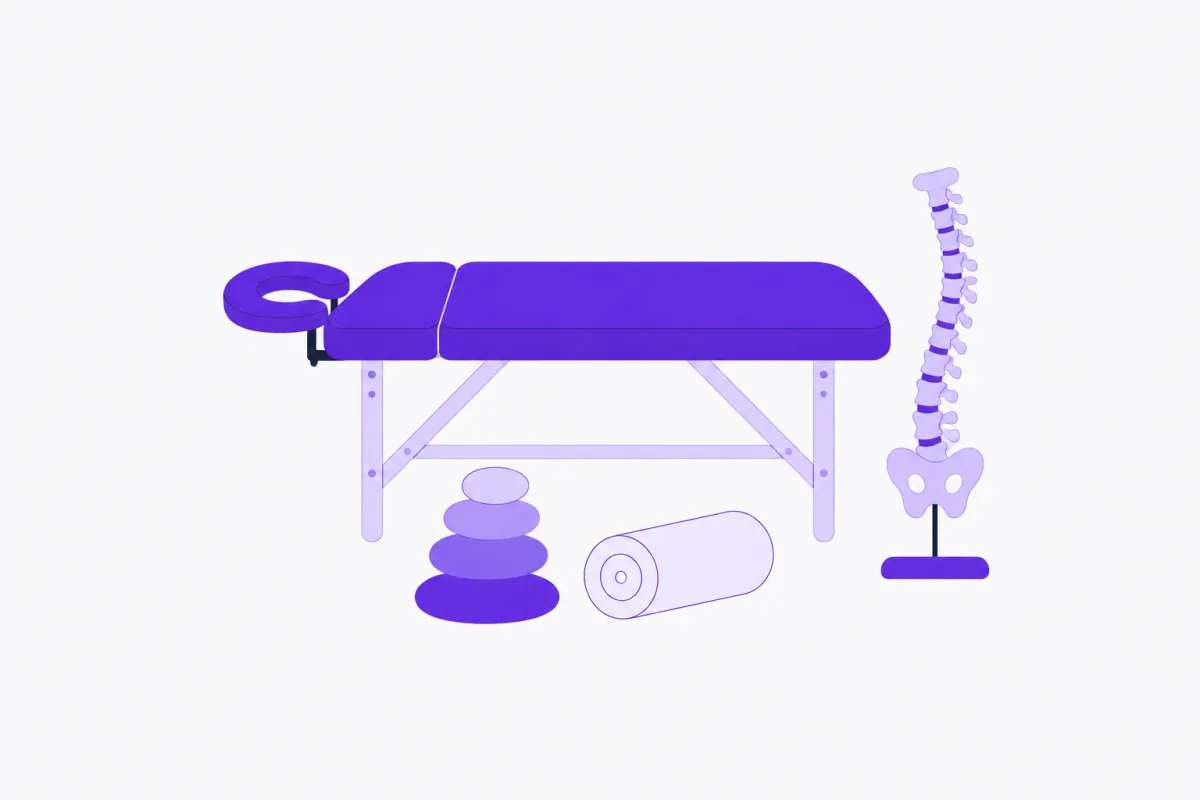
Chiropractic and massage are hands-on work in the most literal sense. When a practitioner is adjusting a spine or forty minutes into a deep-tissue massage, their hands are busy and the phone is across the room. Many small clinics have no one on the front desk at all for parts of the day.
So the phone rings out. A new client with a stiff neck books with the clinic that answered first. A regular who wanted to move Thursday's session leaves a voicemail that sits until lunch. A caller asking whether the 90-minute massage comes in a package hangs up and doesn't try again.
An AI receptionist for chiropractors and massage therapists picks those calls up. It explains your services and packages, books the client with the practitioner and room they need, and sends reminders by email. It doesn't assess pain or recommend treatment; anything clinical goes to a person.
This guide covers how the booking side works when you have several practitioners and rooms, how packages fit in, where the clinical line sits, and what to set up before you switch the phone over.
What is an AI receptionist for chiropractors and massage therapists?
It's software that answers your clinic's phone and website chat in a natural voice, holds a real conversation, and does the front-desk work that doesn't need clinical judgment. In practice that means:
- The clinic line, answered by an AI voice agent on a Twilio number you own, on the first ring, even mid-treatment.
- Your website chat, by typing or speaking, for clients who want to compare a 60- and 90-minute massage at 11 PM.
- Your booking page, which follows exactly the same rules as the phone.
It suits solo chiropractors, massage therapists working from a single room, multi-practitioner wellness clinics, sports massage studios and mobile therapists.
What it won't do: decide whether someone should see a chiropractor or a massage therapist, assess pain, give exercises or stretches, or check an individual's insurance benefits. Those calls go to your team, by transfer or callback.
How an AI receptionist books a treatment
Step 1: It answers and listens for the reason
Every call is answered straight away, in any of 13 languages. The assistant asks what the caller is looking for: a first chiropractic visit, a specific type of massage, a follow-up, or a change to an existing booking.
Step 2: It explains the options in your words
Session lengths, prices, what a first visit involves, what to wear, whether you accept their insurance, and what each package includes are answered from the information you've loaded. The answer doesn't depend on who happens to be free to pick up.
Step 3: It finds a practitioner and a room
This is where clinics with more than one room benefit most. Set each service to need "any practitioner" and "any treatment room", and the assistant books one free choice from each. If the client asks for a specific therapist, it checks that person's own hours and time off.
Step 4: It books, with turnover time built in
Free time after each booking gives the room time to be reset and the practitioner a few minutes between clients. The booking is written to Aiva Chat's appointment book and, if you connect it, Google Calendar. The client gets a confirmation and reminders with a link to move or cancel.
Step 5: It passes on anything clinical
If a caller describes something that sounds serious, such as numbness, a recent car accident, or severe pain, the assistant doesn't book over it. It offers a person, or suggests they seek medical care, following the rules you've written.
Benefits for a chiropractic or massage clinic
Treatments aren't interrupted
Stopping an adjustment to answer the phone isn't good for the client on the table. With the phone covered, practitioners finish the session and check the summaries afterwards.
Rooms and people are booked together
Double-booking a treatment room is a common front-desk error in shared clinics. Because every channel books against the same rooms and staff, a room that's in use simply isn't offered.
Packages are explained the same way every time
Five-session packages, monthly memberships and member discounts tend to be explained differently by different people. The assistant gives the same answer on what's included and what it costs. Clients buy the package or membership in person, and then book with their pass link or code.
Practitioner workload stays realistic
Hands-on work is physically demanding. The US Bureau of Labor Statistics notes in its massage therapists overview that physical endurance limits how many sessions a therapist can give. A daily limit on each practitioner keeps the diary inside what they can actually do.
Regular clients keep their rhythm
Adjustment plans and monthly maintenance massages work best on a fixed rhythm. Repeating bookings let clients hold the same slot every week, two weeks or four weeks.
The phone rings hardest when every pair of hands in the clinic is on a client. That's the call an AI receptionist is for.
Chiropractic and massage use cases
Illustrative example. The clinics and callers below are composites written to show how the setup works. They are not real Aiva Chat customers, and no results are implied.
The new patient with a stiff back
Problem: A caller wants to see a chiropractor this week and asks what the first visit involves. How Aiva Chat handles it: It explains the longer first-visit service, what to bring and what it costs, then offers the first free times. It doesn't comment on the back pain itself. Outcome: A new patient is booked into the right service length, so the chiropractor isn't squeezed into a follow-up slot.
The couple who want a massage together
Problem: Two people want side-by-side massages on Saturday afternoon. How Aiva Chat handles it: If you have a couples room and service, it books that. Otherwise it books two appointments at the same time with two therapists, one per person, and confirms both. Outcome: Both bookings exist in the calendar with the right rooms, rather than one note that says "x2".
The package holder
Problem: A client bought a five-session sports massage package at the desk and wants to book session three. How Aiva Chat handles it: The client books with their pass link, or gives their code on the booking page, and the visit is taken off the pass. Outcome: Visits used and visits left are tracked without anyone counting on a paper card.
The mobile therapist
Problem: A self-employed therapist visits clients at home and can't take calls between visits. How Aiva Chat handles it: It asks for the address and access details and adds them to the booking notes, with travel time built into free time after each booking and a daily visit limit. Outcome: The day stays drivable, and the therapist doesn't have to return calls from the car.
Your website and a small shop for aftercare products
If your clinic's web presence is a social page and a directory listing, the AI website builder can write a site from a few answers about your services, practitioners and approach. It comes with booking at /book and the website chat on every page, at your aivachat.io address, and it's sent to Google.
Aftercare products, reserved for pickup
Many clinics sell pillows, foam rollers, heat packs or massage oils at the desk. The store turns those into a searchable catalog. Clients can reserve an item to collect at their next visit or order on WhatsApp, and the assistant can answer product questions by searching the catalog. It isn't a checkout: you take payment your usual way.
Found locally
Clinics that take bookings online are also listed on Aiva Find by city and kind of business, and you can hide the listing any time.
AI receptionist vs. front desk vs. voicemail
| Front-desk staff | Voicemail | AI receptionist (Aiva Chat) | |
|---|---|---|---|
| Answers during treatments | Yes, if you have one | No | Yes, every call |
| Books practitioner and room together | Usually, with care | No | Yes, every time |
| Explains packages consistently | Varies | No | Same answer every time |
| Sells packages | Yes, in person | No | No, sold in person |
| Clinical judgment | Should defer to practitioners | No | Never, by rule |
| Cost | Wages and cover | Free | $49 to $199 a month, plus your own Twilio and OpenAI usage |
A good front-desk person is the best option and knows your regulars by name. Many small clinics can't justify one full time, and even those that can find the desk busiest at the same moments the phone is.
Voicemail is free but slow. A caller with a sore back wants a time today, not a callback tomorrow. Our post on replacing voicemail with an AI receptionist explains why most people hang up instead of leaving a message.
The AI receptionist answers every call and books accurately, but it doesn't know your regulars the way a person does. Keep a transfer on for anyone who asks for the clinic directly.
How to set up an AI receptionist for your clinic
Step 1: List your services by length
Write out every service with its length and price: first chiropractic visit, follow-up adjustment, 30-, 60- and 90-minute massage, sports massage, pregnancy massage. Add free time after each for room reset.
Step 2: Add practitioners and rooms
Add each chiropractor and therapist as staff with their own hours, days off and an optional daily limit. Add each treatment room as a room. On each service, set what it needs, for example one therapist and one room. The staff, rooms and locations guide walks through it.
Step 3: Set up packages and memberships
Create your packages (number of visits, how long they last) and memberships (monthly visits and any member discount). Your team sells them in person; the assistant explains them and clients book with their pass.
Step 4: Write the clinical rules
Add rules: never assess symptoms, never recommend treatment or exercises, offer a person for anything that sounds serious. Turn on the "mentions an emergency" and "asks for a person" handoffs with a transfer number.
Step 5: Connect phone, calendar and reminders
Connect your Twilio number and OpenAI key. Connect Google Calendar if practitioners keep other commitments there. Choose up to two reminders at 24 hours, 2 hours or 1 hour before.
Step 6: Test and review
Call as a new patient, a regular asking for a specific therapist, a package holder and someone describing worrying symptoms. Check the bookings land with the right person and room, and the clinical call is handed off. Use Insights to see what callers ask most in the first weeks.
Common mistakes clinics make
Forgetting the rooms
If rooms aren't set up, the assistant only knows how many practitioners are free. Two therapists and one room means two bookings that can't both happen. Add every room that limits you.
One service for every massage length
A single "massage" service forces the assistant to guess the length. Separate services for each length keep the diary accurate and the price clear.
Letting it drift into advice
"That sounds like sciatica" is not something the assistant should ever say. Write the rule explicitly and test it with a caller who pushes for an opinion.
Expecting it to take payment
Aiva Chat doesn't take payments, so it won't charge for late cancellations or sell packages on the phone. It can explain your policy; your team takes payment your usual way and can mark a booking as paid.
Relying on texts for reminders
Reminders go out by email with a manage link. Texting is paused in Aiva Chat for now while US carrier registration (A2P 10DLC) is completed, so let clients know to watch their inbox.
Best practices for chiropractic and massage clinics
- Describe each practitioner briefly in their staff profile, including specialties like sports or pregnancy massage.
- Set daily limits that match each person's real capacity.
- Keep first visits as their own service with a longer length.
- Write what to wear and bring so the assistant can tell every new client the same thing.
- Use the waitlist for popular appointment slots, so a cancellation is offered to the next person by email.
- Review a handful of calls each week and fix answers in the knowledge.
Conclusion
Chiropractors and massage therapists lose calls for a simple reason: their hands are on clients for most of the day. An AI receptionist answers those calls, books the right practitioner into the right room for the right length, and explains packages the same way every time, while leaving every clinical question to the people trained to answer it.
The decision point is how carefully you set up rooms and services. A solo therapist with one room can be live in an afternoon. A clinic with several practitioners, rooms and package types should spend an hour getting services and needs right first, because that's what stops double-booked rooms. For a closely related setup, see our guide to AI receptionists for physiotherapy clinics, and for the spa side, booking AI for day spas.
Ready to keep your hands on your clients?
Call +1 (970) 972-0974, ask about a 90-minute massage and a package, and try to book Saturday with a particular therapist.
If it fits your clinic, start a 14-day free trial with no card, add your practitioners and rooms, and point a quiet day's calls at it first. Plans differ mainly by how many calls can be answered at once. If you'd like help setting up rooms and packages, book a demo.
Written by
The Aiva Chat team
Aiva Chat
Posts from the people building Aiva Chat in Rajkot — how the product works, what we have learned building it, and guides for getting the most out of an AI receptionist.
Rajkot, India · at Aiva Chat since 2024
More posts